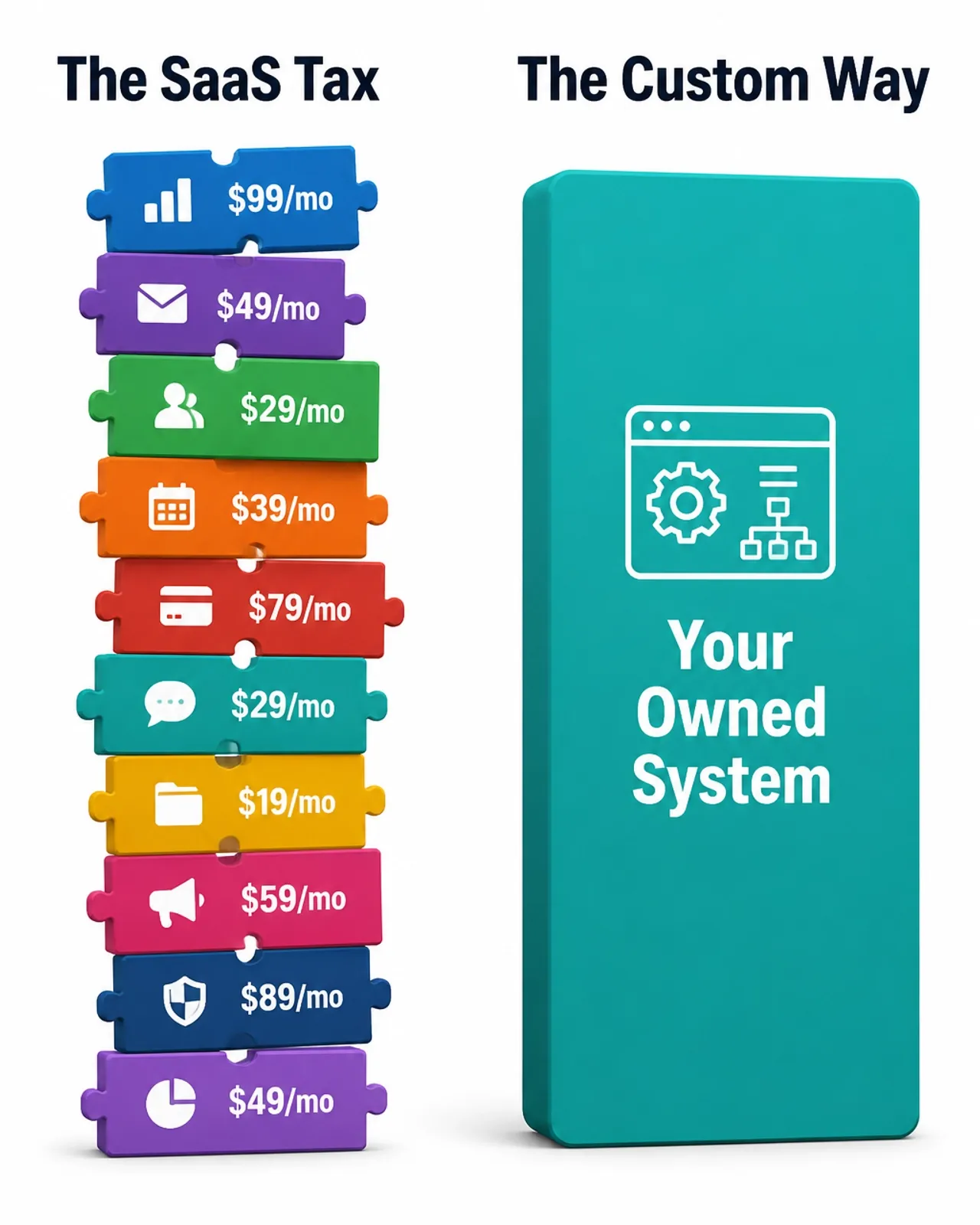
Here is a test. Without opening your bank app, name every software subscription your business pays for. Most owners get partway through and then start guessing. That gap is where SaaS costs for small business quietly grow: a scheduling tool here, an e-signature app there, a project board three people signed up for and one person uses. But I'm not going to tell you to cancel everything. The monthly fee is usually the cheapest part of a tool. The expensive part is what your people do around it. So the real question isn't "do I need 10 subscriptions?" It's "what is each one actually costing me?"
Why the sticker price lies
A $49 tool looks like a $49 tool. On your statement, that's all it is.
In your building, it might be something else. If someone retypes every new customer from that tool into your invoicing software, the $49 tool also costs whatever that person's time is worth. If it doesn't sync with your calendar, it costs a few double bookings a month. If only two of five paid seats get used, it costs more per actual user than the price page says.
Seats alone are a bigger leak than most owners expect. Zylo, a company that tracks software spending, reports that >44% of SaaS licenses are wasted or underutilized. That's the visible waste. The invisible waste is the labor.
The true cost formula for any subscription
For each tool, run this:
True monthly cost = subscription fee + unused seats + (hours of manual work around the tool × your loaded hourly cost)
"Loaded hourly cost" means what an hour of that person actually costs you, wages plus taxes and benefits. Use a rough number. Precision isn't the point.
A worked example (hypothetical)
Picture a 7-person plumbing company in South County. They pay $60 a month for a job scheduling app. The office manager spends about two hours a week copying finished jobs from that app into the accounting software so invoices can go out. Call her loaded cost $30 an hour.
- Fee: $60
- Unused seats: none
- Manual work: roughly 8 hours a month × $30 = $240
True cost: about $300 a month. The app isn't the problem. The gap between the app and accounting is. Cancelling the scheduler saves $60. Connecting it to accounting saves most of the $240 and gets invoices out faster.
That's the pattern I look for. The fix is usually a connection, not a cancellation.
Score your stack: keep, connect, cut or replace
Once you have a true cost for each tool, sort them into four buckets. Do this on paper. It takes about an hour.
- Keep. It does its job, people use it, and nobody retypes data around it. Leave it alone.
- Connect. It does its job, but someone moves data in or out by hand. This is where the money is. Put it at the top of the list.
- Cut. Nobody has logged in for months, or another tool already does the same thing. Cancel it this week. If cutting dead subscriptions is your main issue, the subscription graveyard post goes deeper on that.
- Replace. It truly doesn't fit how you work, and you've bent your process around it for years. This bucket should be small. Only here does custom software make sense.
Don't be surprised if most of your tools land in "keep" and "connect," with a couple of "cuts." That is good news. It means you don't need new software. You need the software you have to talk to itself.
Why I don't tell people to rip it all out
I used to be louder about replacing SaaS with custom builds. I've changed my mind on the default. Software is moving too fast right now. The tool you replace today might ship the exact feature you needed in six months, and the custom thing you built becomes one more thing to maintain.
So my rule is: work with what you have first. Connect it. Add AI where it actually saves time, like drafting follow-up emails or summarizing job notes. Build custom only when nothing on the market fits, and when I do, the client owns it outright. If you're curious what a replacement looks like when it does make sense, I walked through one in how I'd replace five subscriptions in an afternoon.
How I'd approach this
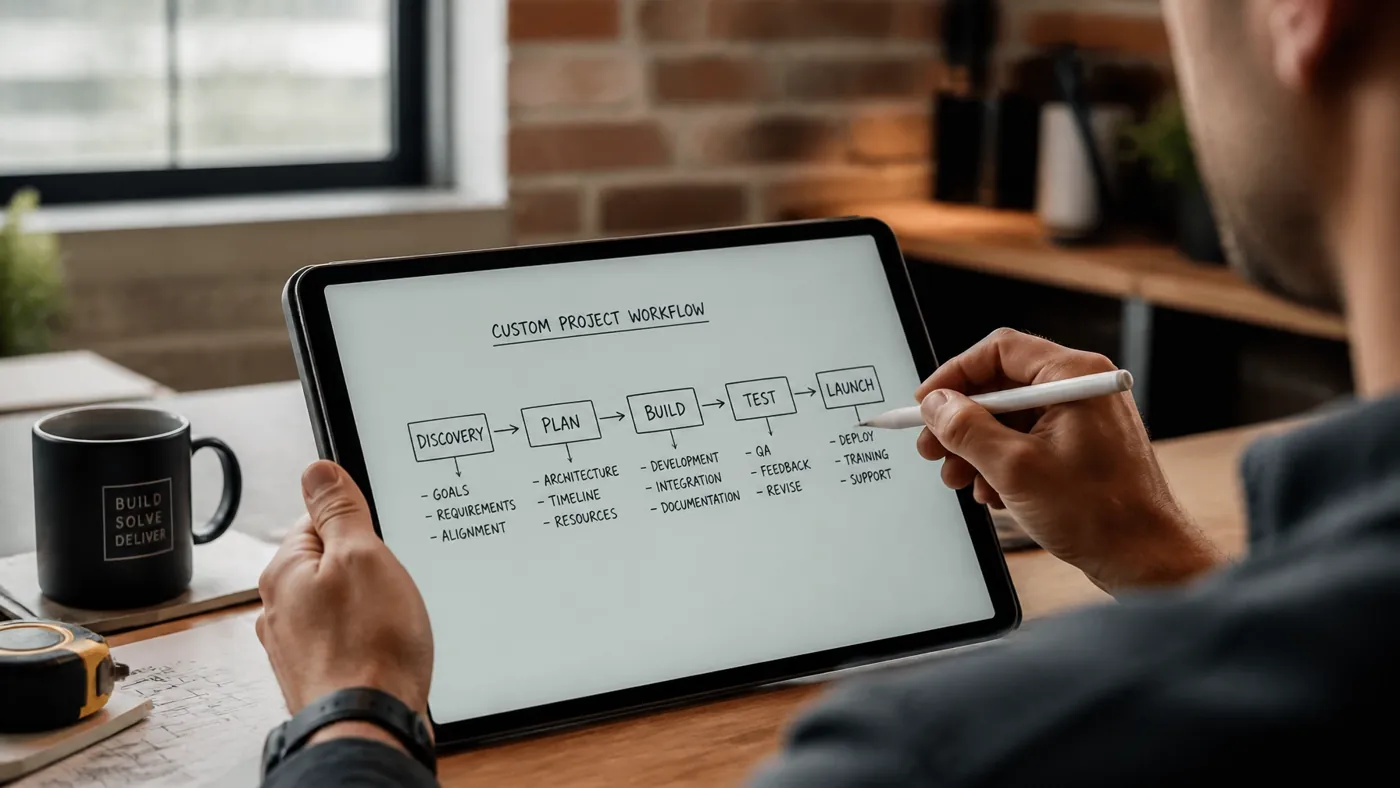
I'm a production guy. I want to see how work actually moves. So I start by tracing one path end to end, usually lead to paid invoice, and I mark every spot where a person touches data a machine could move.
Then I fix the worst one first. Most of the time that means wiring your existing tools together with n8n so a new lead lands in the CRM, the invoice goes out when the job closes and the weekly numbers show up on their own. You can see the usual targets on what I automate, and how the first month runs on how I work. I'm in Overland, about 20 minutes from downtown, but most of this happens over Zoom, so there's no need to block out a morning for a meeting. What it costs is laid out on my pricing page.
Frequently asked questions
How many software subscriptions does a small business need?
There is no right number. A five-person shop might run well on six tools and badly on four. The better question is whether each tool earns its true cost, meaning the fee plus the time your team spends feeding it by hand. Ten connected tools can beat four disconnected ones. Count the copy and paste, not the logos.
What is the true cost of a software subscription?
Take the monthly fee, add the cost of any unused seats, then add the hours each month your team spends moving data into or out of that tool by hand, multiplied by what those hours cost you. That last part is usually the biggest number, and it never shows up on a credit card statement.
Should I replace my software with something custom?
Usually not, and rarely all at once. Software is changing too fast to bet on tearing everything out. Keep tools that do their job, connect them so data moves on its own, and add AI where it saves real time. Build custom only when a tool truly does not fit how you work, and make sure you own what gets built.
What does it cost to have Alex connect my tools?
I charge $125 an hour with a 15-hour monthly minimum, which comes to $1,875 a month. Meetings are free, there is no setup fee, it is month to month, and you own everything I build. The first conversation is 30 minutes about your biggest bottleneck, and I will tell you if the fix is something you can do yourself.
Run the formula on one tool
Pick the subscription that annoys your team the most and run the true cost formula on it. If the number surprises you, book a 30-minute conversation. I'll look at that bottleneck with you and tell you whether to keep, connect, cut or replace it. No pitch.